Monday, January 12, 2015

The Sunne in Splendour, Part 2

Of the many fascinating stories surrounding Richard III and the House of York, the story of the "Sunne in Splendour" is, to me, one of the most amazing ones.

On the morning of February 2, 1461, at Mortimer's Cross, three suns appeared on the horizon.  Medieval minds being what they were, many of Edward's troops viewed this as a bad omen.  Edward thought fast on his feet and convinced his followers that the three suns represented the Holy Trinity & meant that God was on their side.   But why did he make this allusion and why did it work?

Besides the obvious answer, that medieval people were more religious & superstitious than we are, what is often overlooked by many today is that February 2 is also the date the Catholic Church celebrates Candlemas.  Candlemas marks the 40th day after the birth of Jesus & the date of his first presentation at the temple.  It is the day people bring candles to Church to be blessed & borne in procession to signify Jesus' role as "the light of the world."  The origins of Candlemas stem from much older pagan traditions, which mark February 1 or February 2 as Imbolc, the halfway point between winter & spring, "the return of the light."  The appearance of the "Sunne in Splendour" on such an important day, then, had added religious significance for Edward & his troops.  So strong, in fact, that Edward adopted it as his personal device.

So what did this phenomenon look like?  A similar one appeared in my home town a few months ago, but it was at noon.  Yesterday, however, a much more spectacular one appeared in New Mexico, & in my opinion, is more like the one that appeared before the Battle of Mortimer's Cross than other pictures I've come across.  I posted a photograph of it, taken by Joshua Thomas in Red River, New Mexico, at the top of this entry.    See also here  https://www.facebook.com/NWSAmarillo/photos/a.376992752312629.94660.208741279137778/940978792580686/?type=1&theater  

Even though we know what causes this phenomenon today, it still takes our breath away.  More than 500 years on, it is still easy for us to see why Edward & his followers were so in awe & considered it a sign of God's favor.

Thursday, January 1, 2015

The Forgotten Son of York

First of all, I hope everyone reading this had a wonderful & safe holiday season. 2015 will be a banner year for Ricardians worldwide, as this is the year King Richard III finally gets permanent tomb where we can visit to pay our respects.

Lately, however, I've been wondering about Edmund, Richard's older brother who died at 17 when he was murdered by Clifford the Butcher.  What would his life have been like, had he survived to help Edward win the Crown? What would have happened to George & Richard then, as well?  And what I really want to know is: what personal device did Edmund use?

My curiosity was piqued by a photograph of the pulpit donated to Fotheringhay Church by Edward IV, which includes the Sunne in Splendour, the Black Bull of Clarence, and the White Boar of Gloucester.  All of these are the personal devices of Edward IV, George, & Richard respectively.  But what about Edmund? Why did Edward leave his brother out?  As they were raised together at Ludlow, I don't think it was oversight, but that Edmund didn't have a personal device. I puzzled over this because George & Richard selected theirs when they were barely in their teens. Certainly Edmund would have chosen his around that age too, right?

Well, in answer to my query, several people pointed out that younger, unmarried sons used their father's if their father was still alive.  Since both Richard, Duke of York and Edmund, Earl of Rutland both died at & after Wakefield, Edmund may not have had his own device. He did, however, carry his own coat of arms, the same coat of arms used by Edward, Earl of March.


Someone else pointed out the possibility that Edmund's device was the peacock as that has long been associated with the Earls of Rutland. So of course, I had to go look that up.

It is true that the peacock is associated with the Dukes & Earls of Rutland, but only as far back at Thomas Manners, First Earl of Rutland, as created by Henry VIII in 1525.  Thomas Manners was not only a favorite of the king, they were cousins. Manners was the grandson of Anne of York, sister of Edward IV & Richard III. The peacock appears at the top of his Garter Stall plate:


While the peacock appears in many other places associated with the Earls, & later Dukes, of Rutland, titles still held by the Manners family, it does not seem to have any association with the York family in general nor Edmund in particular.  Or does it?

In medieval times, the peacock symbolized resurrection.  Could Henry VIII himself have selected the peacock as the symbol for the Earl of Rutland, as he was, in a sense, resurrecting a title that had died with his uncle Edmund 65 years earlier? And if so, why was Henry VIII going around resurrecting a Yorkist title?


Monday, December 8, 2014

The Case for Haplogroup G

While the research released last week could not prove conclusively what the Plantagenet Y Chromosome was, it did NOT say that it proved Richard was not a Plantagenet though his father's side. No matter how badly historians & writers want to spin it that way, such statements are false & misleading. Here's a spoiler alert for Phillipa Gregory's next novel: Isabella of Castille has an affair with John Holland & gets pregnant with Richard of Conisburgh. :cough: Didn't happen :cough:

The Y-Chromosome identified in Richard III's remains was Haplogroup G, specifically G2-P287+.  I admit, everything after the "G" still reads like gobbletygook to me.  However, I have learned a couple of interesting things about Haplogroup G & men who have carried it.

According to Wikipedia, Haplogroup G first appeared in the Middle East during Neolithic times &  arrived in Europe with migrations of farmers & settlers from that region.  The earliest European remains belonging to this Haplogroup have been dated to 5000-3000 B.C.E.,  & have been found in Spain, France, Bavaria, & the Italian Alps.  Although this haplogroup is widespread, it is not very common.

Looking beyond the findings of last week's report, however, there is still some strong evidence that Haplogroup G is the correct Haplogroup for the Plantagenet Dynasty.  First, there are only 3 generations separating Richard III and Edward III. Second, remains supposedly belonging to Henry IV of France & Louis XVI both were found to have belonged to men in Haplogroup G.  Since this haplogroup is rare in Western Europe, it is hard to wave off  these findings it in 3 different kings from different countries & centuries  as "coincidence."


Thursday, December 4, 2014

Let's Talk Paternity

It's been just over 24 hours since the release of "The Identification of the Remains of King Richard III" (link: http://www.nature.com/ncomms/2014/141202/ncomms6631/full/ncomms6631.html ) & already the report has been misinterpreted & misunderstood, despite the very best efforts of the authors to fully explain what it was they were looking for and what they found.  I really recommend reading the report & watching the attendant videos on Youtube. These are primary sources & those should be consulted & cited before any news article in the media, especially ones that shout    "Richard was Illegitimate" should be. (By the way, he was not.)

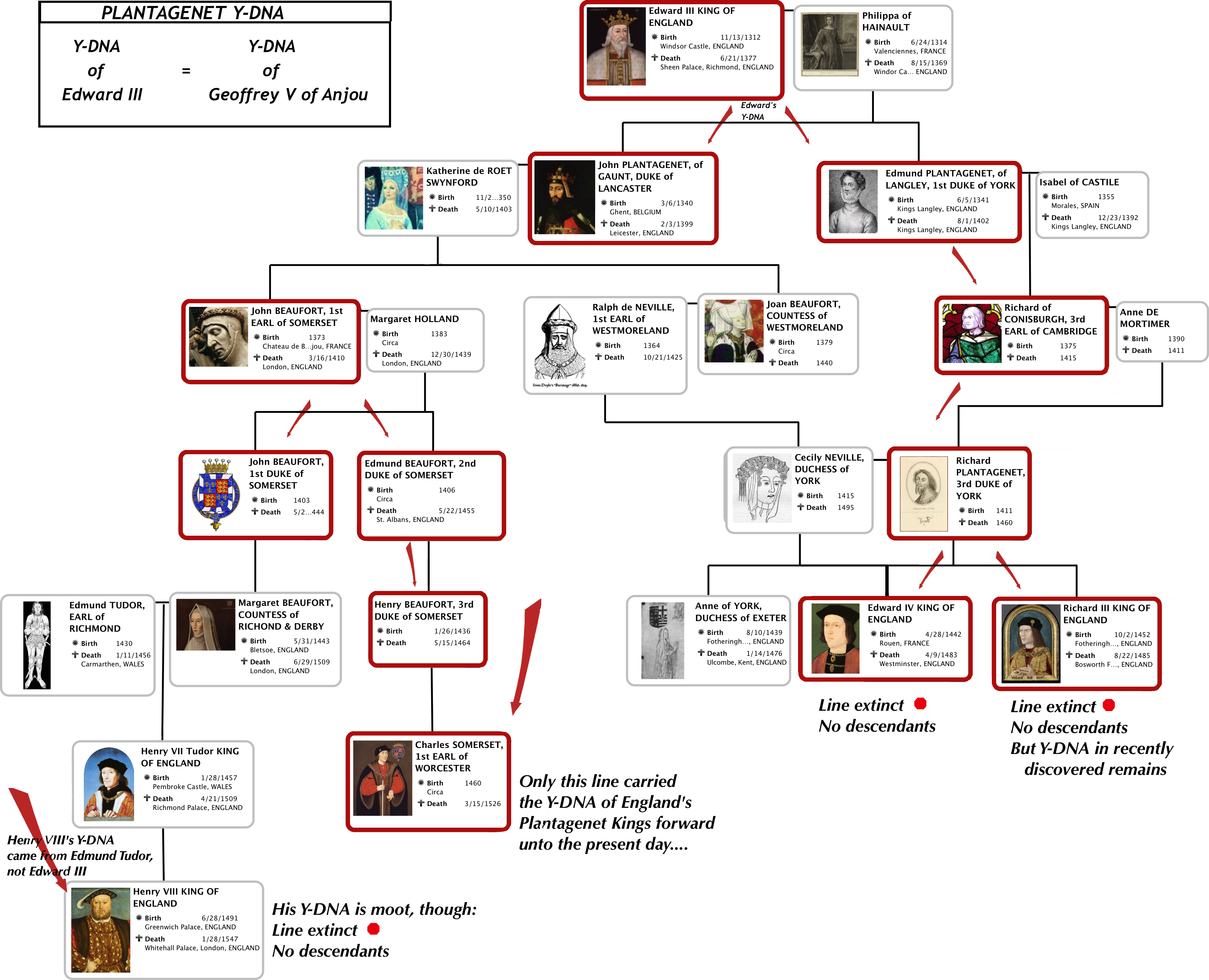
The report cited above also has a nice chart that shows the paternal descent from Edward III, as well as descent from Cecily Neville along the female line.  The research along Cecily's line was used to prove the theory of John Ashdown-Hill, which disproves the allegations that the University thought little of his work.  The chart can be viewed here: http://www.nature.com/ncomms/2014/141202/ncomms6631/fig_tab/ncomms6631_F1.html

The above chart leaves out Margaret Beaufort's connection to Edward III (it was not relevant to the research at hand), but this chart does include her, as well as Joan Beaufort, & is worth reviewing, if only to keep the various branches of the Plantagenet family tree straight:  https://roots2now.files.wordpress.com/2013/02/r3h722.png

As for breaks in the Y-Chromosome chain, those could have happened at any point along the way. For all we know, there was a break in the Y-Chromosome between Henry II & Edward III. But for the sake of this blog (& our sanity), let's presume there was no break between these two kings.  Where else could this "non-paternity event" have occurred?  Listed below are, in my opinion, the top likely places:

#1.  John Beaufort: Son of Katherine Roet & John of Gaunt, according to history.  However, John's birth is given as occurring between 1371 & 1373.  Katherine's first husband, Hugh Swynford, died sometime between those years as well. It is possible that Katherine was pregnant by her first husband & didn't know it. John Beaufort was Margaret Beaufort's father.

If, however, John Beaufort was the son of John of Gaunt, then the Tudors were descended from the Plantagenets via Margaret Beaufort, the mother of Henry Tudor.  The break in the Y-Chromosome would have happened at a later date. What is needed is better documentation on when Hugh Swynford died & when John Beaufort was born.  In order to completely exclude Hugh Swynford as the presumed father (he was, after all, married to Katherine), John Beaufort's date of birth must be after August/September 1372.

#2 Richard of Conisburgh (Richard III's paternal grandfather): rumors of the time suggested he was fathered by John Holland, with whom his mother, Isabella of Castille, had a scandalous affair.  He was not mentioned in his father's or his brother's wills.  However, because Richard III's Y-Chromosome has strong connections to France, it is unlikely that it was inherited through Holland.  The Holland family appears in England in the early 13th Century & has no known paternal links to France.

These are just possible places where the break  between Richard III & the Somersets could have occurred.  In order to prove or disprove these theories, further testing needs to be done. Since that would lead to more tomb raiding, I just don't see that happening, so I guess the search for the Plantagenet Y Chromosome ends here.


Tuesday, December 2, 2014

Paternity v. Seniority

With the news breaking today regarding the Plantagenet DNA, it seems that people are already confusing paternity with seniority. While both of these concepts come into play regarding inheritance (in this case, the throne of England), they are not the same thing.

One of the things that researchers had hoped to discover was the elusive Plantagenet Y-Chromosome.  This chromosome can only be passed down from father to son. (Conversely, the mtDNA is passed from a mother to all of her children, but only her daughters will pass it along to their children. See http://sunnesandroses.blogspot.com/2014/03/joan-beaufort-her-many-descendants.html )

In order to determine conclusively what the Y-chromosome for the Plantagenets was, there needed to be a genetic match between the DNA of Richard III & that of the male descendants of John Beaufort, the 1st Earl of Somerset, the son of John of Gaunt.  Unfortunately, there was no match.  When & where the break (or breaks) in the line occurred are a mystery & I'm sure they will be the source of endless speculation.  I'm already doing some preliminary research in this area.

While Richard III was also a descendant of John of Gaunt, it was through one of his daughters, Joan, so he would not have inherited the Plantagenet Y Chromosome that way.  The most recent common male ancestor for Richard and John of Gaunt was Edward III, as Richard is a direct descendant along the male line from Edward III's fifth son, Edmund of Langley. 

Seniority, on the other hand, determines which child (or sibling) had the right to inherit the throne.  Until quite recently, the throne was passed by right of primogeniture, meaning the eldest son (or brother, if the King had no children) became the next King.  All sons (or brothers) had precedence over all daughters (or sisters), regardless of their age.  This explains why Edward VI became King after Henry VIII died & not Henry's oldest child, Mary.  If the King had no sons, then his eldest daughter would become Queen, which is exactly what happened when Edward VI died. 

Applying seniority to the case of the Yorks & Lancasters, this means that Richard's family had seniority over the Lancastrians, even though their claim was through Anne Mortimer, who was the great-granddaughter of Lionel of Antwerp, third son of Edward III.  In contrast, the Lancastrian Kings (and later, the Beauforts) were descendants of the fourth son of Edward III, John of Gaunt.

I hope this explanation was helpful. I tried to make it as clear as I could, but as always, when you're so related to yourself that you could be your own grandfather, things tend to get complicated & frustrating. But that's what makes genealogy fun!

I Told You So

Ok, I admit, that's really a message for Michael Hicks, but  news out of Leicester today indicates that the DNA recovered from Skeleton 1 proves that the remains located under the car park were those of Richard III. You read it here first, though:

http://sunnesandroses.blogspot.com/2014/03/joan-beaufort-her-many-descendants.html

There is other, more interesting news, though, concerning the Y chromosome that is passed through the male line. Apparently, there the connection between Richard III and those descendants of Edward III who were previously identified as Plantagents has been broken by one or more instances of "non-paternity."

It will take some time to sort through all of this, but I do intend to write about this too within the next few days.

But oh, how I love being able to say 'I TOLD YOU SO!"

Friday, November 21, 2014

In Every Sense of the Word

Of late, the word "celebrate" has caused some consternation among the anti-Leicester brigade.  They looked for something to be offended by, found it, & acted accordingly. Knee-jerk reaction letters to the editor & rants on social media immediately appeared. 

It seems to me that the blood pressures (& reputations) of these folks would have been better served had they just taken the time to crack open a dictionary or, in case dictionaries are extinct in the U.K., conduct a search on Google & they would have instantly seen that "celebrate" has many meanings. Here's what I found (in 0.35 seconds):

cel·e·brate
ˈseləˌbrāt/
verb
  1. 1.
    publicly acknowledge (a significant or happy day or event) with a social gathering or enjoyable activity.
    "they were celebrating their wedding anniversary at a restaurant"
    synonyms:commemorateobservemarkkeephonorremembermemorialize
    "they were celebrating their wedding anniversary"
  2. 2.
    perform (a religious ceremony) publicly and duly, in particular officiate at (the Eucharist).
    "he celebrated holy communion"

Oops.

Make no mistake, there will be celebrations in every sense of the word in Leicester next March.  It will be the largest gathering of Ricardians in history, past & future, after all.  Outside of the various religious ceremonies, people are bound to meet up in bars & restaurants, bend a few elbows, crack a some jokes, in short do what ever like-minded humans do whenever they gather in large numbers.

But just because we may be smiling & laughing from time to time does not mean we will be acting like that when any of the religious ceremonies is celebrated.   Those will be solemn occasions & of course we will act accordingly.